
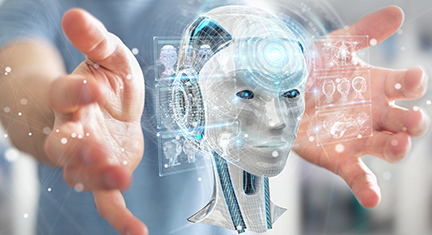

 One of the top priorities for our team is to integrate AI into our work processes, successfully. If you follow my work, then you understand that I’m someone who cares very much about human relationships. Concerning artificial intelligence, I don’t see it as an opportunity to cut costs by cutting in staff. I see it as a chance to make humans better in doing their work.
Yes, there are business owners who are eying AI with the intent of seeing how it can cut the personnel line in their budget, but I’m not one of them. I think that best to take things in moderation and think through ideas and new technology thoughtfully before implementation. Let’s face it. If business and society are seeking to eliminate as many jobs as possible, who is going to be buying the products and services of small business if they don’t have jobs because AI has taken them?
As an entrepreneur, one of the most important elements I think small business owners have to struggle with is trust in artificial intelligence. I’m not the only person who believes that confidence in AI is a significant challenge.
Questions for Making AI Responsible
Recently, PwC published its report concerning its predictions for artificial intelligence. One of the top predictions was about the trust of AI concerning privacy, employment, privacy, etc. AI has entered into the broader society, and people are starting to ask the profound question if it can be trusted. As PwC reported, executives in business consider it one of the top challenges for their companies.
The questions that are being asked, as was stated in the PwC report include the following in addressing this fundamental business and social challenge.
- Fairness: Are we minimizing bias in our data and AI models? Are we addressing bias when we use AI?
- Interpretability: Can we explain how an AI model makes decisions? Can we ensure those decisions are accurate?
- Robustness and security: Can we rely on an AI system’s performance? Are our AI systems vulnerable to attack?
- Governance: Who is accountable for AI systems? Do we have the proper controls in place?
- System ethics: Do our AI systems comply with regulations? How will they impact our employees and customers?
AI Trust in Recruiting
The reality is that AI is not going to go away and we’re going to have to figure out how to incorporate AI into human existence. It doesn’t matter the size of your business; the chances are high that you may have started to integrate already AI into your company without perhaps even realizing it. For instance, if your marketing team may be using Facebook chatbots (AI) to communicate with the public or customers.
We’ve started incorporating AI in our work. Our team has been using Higherme.com for recruiting, as an example. This platform helps us rank applicants to our open positions, but one thing that we make sure to do to maintain trust is to have a human executive look at each of the applications submitted. What does this do? It helps us build confidence for AI internally within our team because they realize that although we do use artificial intelligence for recruiting, there’s always a human responsible for overseeing everything and going through each application. For the broader community, it helps build trust because we can credibly tell applicants that human eyes look at each application submitted, but AI assists us in ranking and prioritizing the order in which we want to see candidates.
Additional AI Trust Opportunities
There are a number of other ways that your company can ensure that trust is built into the integration of AI, which means keeping humans as the overseers and masters. Depending on the structure of your company, you can create an ethics board or committee that will oversee the strategy and ethical use of artificial intelligence in your company.
If you are the owner of a smaller business, it may be too much for your company to have a full ethics board. Another strategy is to hire a chief ethics officer for technology, or you can incorporate it into the responsibilities of your operations team. Assuming you take either of these approaches, you need to have experts in technology on hand who understand the ethical, legal and reputational implications to your business regarding artificial intelligence. Again, the idea is always to keep humans overseeing the policies and processes concerning the use of AI.
Ultimately, business owners have to think carefully about artificial intelligence and move it to the top of the list of their priorities. Audit and understand how and where AI is used in your business. Think about how the use of AI affects humans. It’s easy to like the shiny new toys that will come in the form of AI. But it always has to be weighed with how it will impact your business, employees, customers (i.e., humans). Remember, your company’s reputation rests on your ethics, integrity and how you do business, including with the use of artificial intelligence.
© 2019 Wayne Elsey. All Rights Reserved