
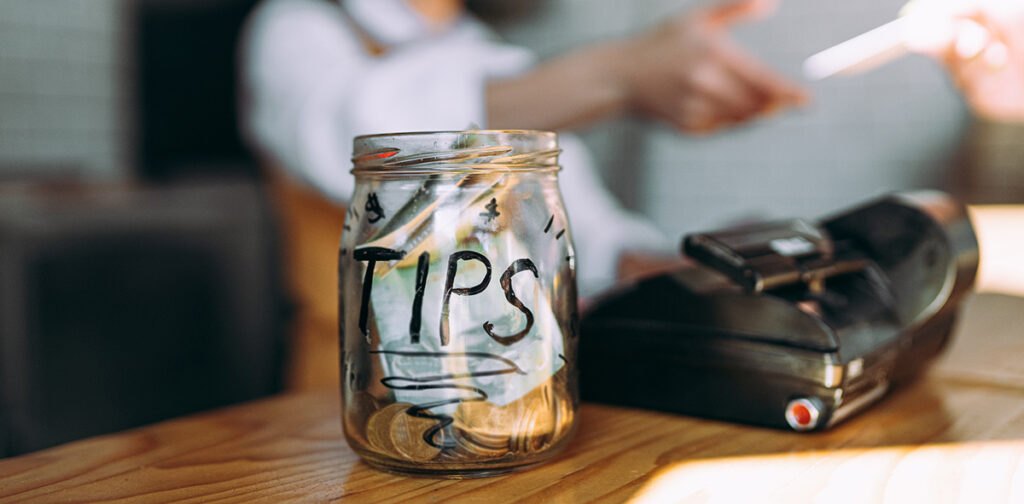

Recently, I visited my family and stopped by Auntie Anne’s for a pretzel. It was nothing fancy, and I just needed a bit of a boost at the mall. When the cashier rang up the pretzel, she motioned to the POS machine so I could tap my phone, and as she said it, she told me to make a choice. I was confused, so I asked why. It was in that moment that I realized tipping culture is out of control and bad for business and workers.
The clerk told me to choose a tip of “15%, 20%, 25% or Other” to provide a tip. Before I tapped my phone, I asked her who gets the tip? Did she get the tip? She was honest and answered, “I don’t.” I looked at her, then firmly pressed Other and typed $0.00. Why should I or anyone, especially families who need to save money quickly, walk through the mall and have to tip a clerk for doing her job in about 2 minutes?
And why should Auntie Anne or any other franchise or company take a customer’s tip for anything but the clerk or server? Since when did a tip become another revenue line for companies? Sure, we’re used to tipping service workers like servers or delivery people, but tipping culture has become so common that it’s now part of almost any interaction, like getting a pretzel or ice cream.
The Rise of Modern Tipping Culture
For generations, tipping culture included tipping servers at restaurants or delivery people for, say, a pizza. You might also tip a taxi driver. All of these workers worked in traditionally low-paid jobs because the culture was that they made their money from good service and tips. But it’s “gone haywire,” and Americans are sick and tired of it. In fact, according to Forbes, “…Nearly 90% of Americans believing tipping is out of control.”
Why Tipping Culture Is Bad for Everyone
As an entrepreneur, I’m always looking at the bottom line. But when we have tipping on everything, including a pretzel, we need to call it out for what it is, which is bad for business. You see, now that I know the Auntie Ann’s franchise is essentially adding costs to their already expensive pretzels, with the appearance that it’s going to the servers, I’m not going back if I can help it. I’ll take my business someplace else because excessive tipping does the following:
1. It Perpetuates Low Wages
When companies get away with asking customers for tips while not giving it to workers, it makes low wages even worse. In many states, workers earn a “tipped minimum wage” that’s less than the regular minimum wage. In the best case, workers rely on customer generosity. At worst, patrons are subsidizing companies’ payroll.
2. Tipping Creates Social Guilt
When you press “Other” on a POS system and then $0.00, it doesn’t feel good. Knowing from the server that she wasn’t going to get any tip made it easier, but asking for the tip is akin to emotional blackmail. That guilt is manipulative and intentional because the server is standing there and sees what you’re doing.
3. It’s Not Going Where You Think
I asked the clerk if she was getting the tip, and she didn’t lie. But here’s the thing: many tips don’t reach where you think they’re supposed to go —the service worker’s pocket. I bet if her manager was within earshot, to keep her job, she would have lied and told me, of course, the tip went to her, so she could keep her job. Tipping culture is a shell game.
4. Tipping is Bad Economics
Asking tips from everyone for everything is leading to immense inflation fatigue. People are tired for service fees getting tagged onto everything while salaries stay flat and don’t raise with inflation. The average revenue of an Auntie Ann’s franchise is between $768,870 and $1,534,865. That’s enough to pay a fair wage.
What We Need Instead of Tipping
Tipping is a custom of another era, and it’s time to move past it, across the board. The public and families have enough stress earning tipped minimum wages in the service industry, or patrons experiencing guilt, to add more money to already expensive products to pad companies’ bottom lines. How about companies pay workers a fair wage, and not guilt customers into subsidizing their company expenses on salaries?
Customers can’t serve as moral middlepersons for payroll. Tipping isn’t a show of appreciation for a job well done as it used to be. Tipping culture is now a symptom of a broken system that includes digital guilt, low wages, and our subsidization of franchises and corporations. It’s a sweet deal for franchise and large corporate owners, but it’s not good for the average American. So, let’s right the ship and do the right thing by workers and customers.
Visit Elsey Enterprises for ideas about business growth.
© 2025 Wayne Elsey. All Rights Reserved.