
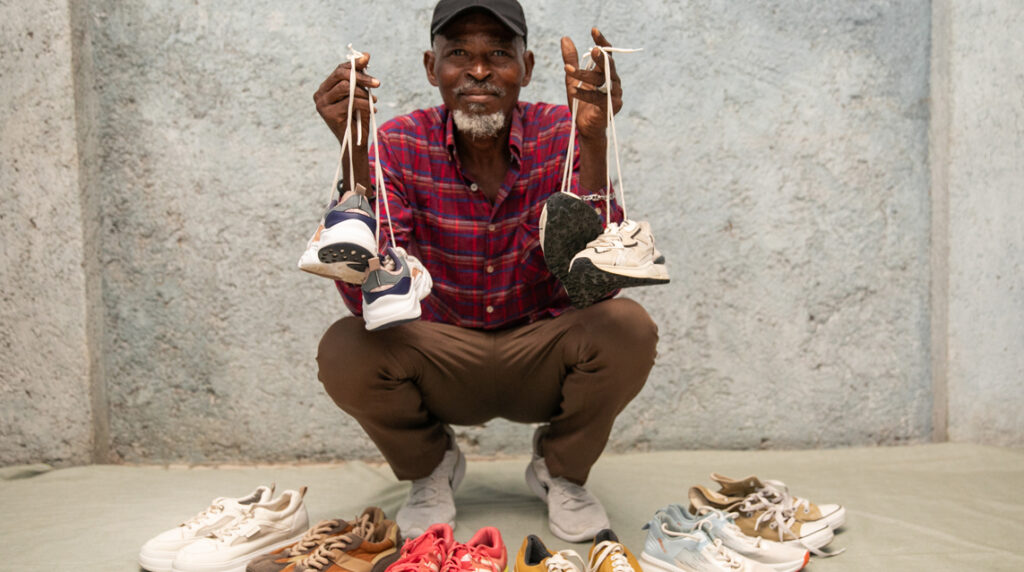

I’d like to tell you about Roosevelt, who lives in the Caribbean. To earn a living, he sold candy to feed his eight kids, but he didn’t earn enough. So, one day, his brother suggested that he sell shoes. That suggestion changed his life, and with a steady income, he was able to provide for his family in the reuse economy. Roosevelt is but one of the more than 4,000 micro-enterprise partners who have the privilege of working with my social enterprise brands, Funds2Orgs, Sneakers4Good, and now, TreeRaise.
The reuse economy, in brief, is about extending the life of manufactured items and redirecting them away from the waste stream to the reuse stream. Because of the reuse economy, Roosevelt can take care of his children. He’s not looking for a handout, and neither are so many of the people I’ve had the honor to know through my work. Roosevelt and our micro-enterprise partners want a chance and opportunity, as every family does. We’ve bridged the gap between socially responsible shoes and sneaker repurposing in the reuse economy.
It’s not a concept or policy paper. It’s real people, lives, and food on the table.
► Learn About the Reuse Economy
We Have a Problem We Keep Ignoring
Every year, 100 to 150 billion articles of clothing are manufactured. But if you do the math, there’s about 8.2 billion people on the planet. Therefore, we produce about 12 to 18 pieces of clothing for every person each year. How do we do it? Cheap synthetics are designed to degrade quickly, which is why the reuse economy (i.e., the circular economy) is critical.
Fast fashion, including shoes and sneakers, has flooded the market. Here are a few quick stats from my book about the reuse economy.
Americans buy 148 fast fashion items each week.
65% of Gen Z throw at least one item of clothing each month.
Textiles are the 4th most damaging industry to the environment.
More than 70% of the world’s global population wears gently worn, used and new shoes and sneakers.
The “take, make, waste” model, which is the traditional linear economic model, is not sustainable. We can’t continue to accept the destruction that it’s causing to the planet and people’s lives due to the climate crisis. But it’s not just about the environment; it also affects everyone socially through manipulation.
Who’s Behind Throwaway Culture, and Why
While I was writing my book about the reuse economy, which shares real stories about the lives affected, I watched the documentary Buy Now! The Shopping Conspiracy. The movie served as a reminder that corporations exist to maximize profits, not to serve consumers. Unfortunately, throwaway culture is part of the recipe for some corporations.
The documentary spoke to how they operate on five maxims to sell more, waste more, lie more, hide more, and control more. Brands such as H&M, Zara, and Shein, for example, could, if they wanted to, release two collections a year, as is traditional. They don’t do that. They keep churning out new products, so you’re always reaching for your wallet.
Planned obsolescence is baked into so much of what is made in throwaway culture. Mobile phones and computers are designed to fail after a certain period. Shoes hoes fall apart after some wear, and clothing isn’t breathable or designed to last. The reuse economy depends on quality, as do the lives of the people I feature (and more) in my book.
What Is the Reuse Economy, Really?
I use the term ‘reuse economy’ interchangeably with ‘circular economy’. The most important thing to understand is that it’s the alternative to the “take, make, waste” model. The reuse economy aims to extend the life cycle of manufactured products. That’s what we do every day with our partners in the U.S. to gather gently worn, used and news shoes and sneakers.
Instead of extracting more resources, manufacturing, selling, and landfilling, the reuse economy keeps products in circulation for as long as possible. It’s different from recycling, which breaks items down and then remanufactures the materials, which is energy-intensive and expensive. We take Air Jordans, for example, and get them to a market in Kenya for a new lease on life.
The Reuse Economy Is Also an American Story
Activity for the reuse economy isn’t just happening in other countries. Each day, our team sees many communities across the U.S. partner with us through our shoe drive fundraising programs, sneaker reuse programs, or even our tree-planting programs. Americans see that shifting toward sustainability makes sense and is better than fast fashion.
But it’s not just our work. In San Antonio, a sustainable store called Spare Parts gathers used art supplies and redirects them to schools that can’t afford them. In Portland, repair projects turn empty lots into shared spaces, and in Loredo, urban farming workshops teach residents how to grow healthier food for themselves.
Your Choices Are Votes
Do you want to know what I really appreciate of the reuse economy? It’s because in a divided country, it’s not a left-or-right, liberal-or-conservative ideal. It’s about being smart about the resources that already exist, and as a business owner, it’s about connecting profit with purpose. The reuse economy is a win for business owners and workers.
As I wrote in my book, the reuse economy already has a market value the exceeds $517 billion. Moreover, it’s expected to reach $798 billion by 2029, and the second-hand reuse market is growing faster than traditional retail. In fact, consumers will pay almost 10% more for sustainably sourced products, even during periods of inflation.
When people understand what’s at stake for fully understanding the answer to the question, what is the reuse economy, they want to do the right thing. My team and I see it every day in our work. But there is a challenge that is related to motivation. The challenge is awareness and helping people understand how they can participate in the reuse economy.
Every purchase is a vote. When you choose vintage or second-hand over buying new, you’re taking a step toward the reuse economy. When you repair rather than replace, or choose quality over cheap quantity, it’s a way to redirect attention from the traditional models created by corporations toward activities that are much more impactful.
The Reuse Economy Tipping Point Is Now
As I mentioned, awareness is the key to becoming a member of the reuse economy with the thousands and thousands of others who choose to be there instead of doing things in a wasteful way. For shoes and sneakers, we invite you to join tens of thousands of partners and communities with our brands.
We’re at a tipping point. There’s energy in doing better by each other and the planet. Again, people just have to understand how and why the reuse economy makes sense in their lives. My book, The Reuse Economy: Breaking Free from Throwaway Culture, goes deep into it with data, real stories, and a roadmap for what you can do today. I invite you to pick it up.
► Download your free resources from me.
© 2026 Wayne Elsey. All Rights Reserved.