
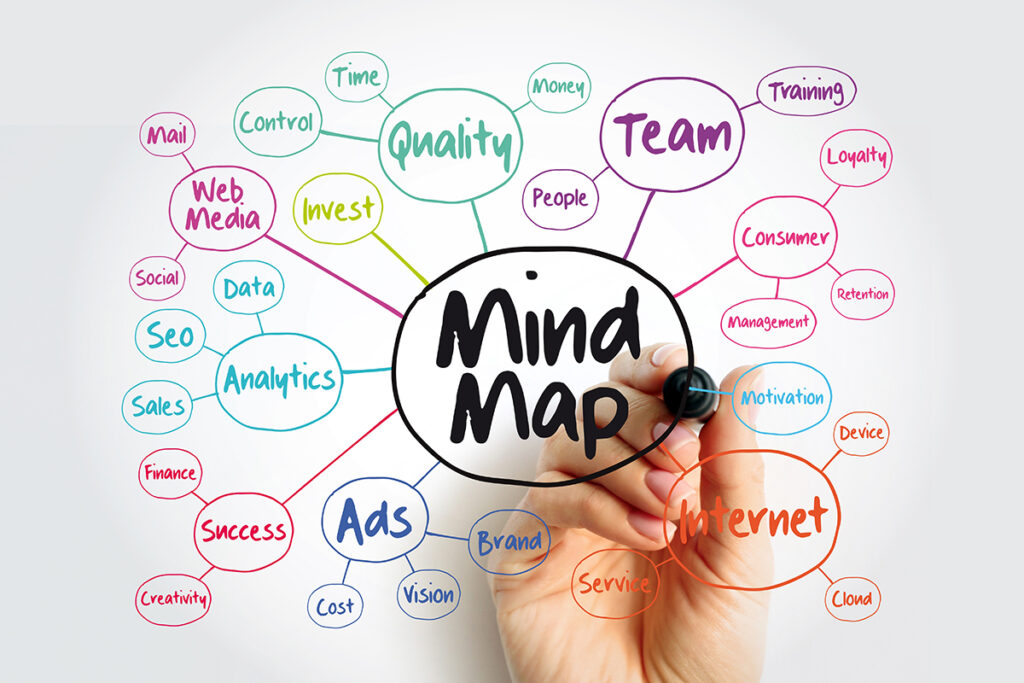


The brain is an organ that has a lot of muscle and horsepower. So, the more you use it, the stronger it gets. That’s where mind mapping comes in. It’s an activity that helps you brainstorm by organizing and visualizing your thoughts. Also, it can help you process information better, come up with new ideas, and solve problems more efficiently. By using mind maps, you can also improve your memory and help deal with uncertainty in business. In short, it gives you clarity.
Mind mapping is helpful for anyone who has to make a decision quickly and needs to think on their feet. Now, wouldn’t that be all leaders and managers? So, if you want to know how to improve your productivity through the power of mind mapping, keep reading.
What is Mind Mapping?
Mind mapping is an activity that helps you to brainstorm, process information, and think more creatively by organizing your thoughts visually. It’s faster than traditional note-taking because it summarizes critical points and arranges them on one page.
Our brains light up with connections between different ideas when we think creatively. In turn, the ideas get transferred into the mind map. In so doing, we develop our brain’s creativity. And that ultimately opens up new thoughts and ideas. Also, mind maps help us get better at solving problems too.
Sure, it can take some practice to master the art of doing it, but it’s worth it! You may need a little bit of time to get used to the flow. But once you do, it should become natural for you after a time of practice.
Why Is a Mind Map Beneficial for Productivity?
Mind mapping is an activity that helps you to brainstorm, process information, and think more creatively by organizing your thoughts visually. Mind mapping is faster than traditional note-taking because it summarizes critical points and arranges them on one page. So, it’s a great idea to use it as an element of learning new skills. In short, it’s a great way to brainstorm and process information.
Mind mapping is a technique that has a significant benefit. It brings clarity to your thoughts. As we all know, business leaders and managers have to address complex problems. And in the digital era, there are always many moving parts to strategic decisions. By doing it, you pick up on the key points, which allows you to focus on central ideas. So, you get rid of the extraneous issues. And that increases your productivity.
What Do You Need to Start?
Before starting a mind map, you need to know some basics. Mind maps get most used as brainstorming tools. So it’s vital to have a list of all the ideas you want to generate for your project. Plus, if you plan on sharing your mind map with someone else, it’s best to use symbols to keep everyone on the same page.
Then, once you have your list of ideas, start by drawing a circle and title it with the name of your project. After that, draw lines out from this initial point that represent particular topics or sub-topics related to your project. Draw lines out from each topic and connect them to other relevant ideas that correspond with that idea. You can then decide which issue is most important and place it at the cluster’s center.
Anyone who has ever tried brain mapping knows that they make decision-making more straightforward and faster than ever. There are many ways in which you can use mind maps creatively. They make brainstorming easy because they allow people to visualize their thoughts in an organized manner without any stress or confusion.
Tips to Create a Good Visual
You can make a mind map for anything you want. But if you struggle to come up with ideas, here are some tips for creating a good visual:
- Make sure the central idea is clear and easy to identify.
- Use images, phrases, keywords, and symbols to help you get your point across.
- Use circles or arrows to connect items that relate. (This helps visually show your thoughts.)
- Start with the most critical information first and work your way down in order of importance.
- Use symbols, colors, and images to make mind mapping more memorable after brainstorming.
- If you want more structure, you could add the following elements to the mind map list:
- Idea keywords
- Desired outcome
- Prioritized action steps
- Competitors
- Alternatives
Experiment and Label Information
The best way to improve productivity for mind mapping is to experiment with different templates and layouts. Mind maps are flexible, so find one that works for the type of work at hand. Finally, remember when it comes to mind mapping to label everything clearly. When you tag your items properly, you don’t forget your ideas. So, if you map a presentation, mark the title and subtitle of your talk. Label the main points and subpoints as well.
Also, if your mind map is complex, include an index at the bottom so that people can find information quickly and easily. This way, your team won’t have to go through every point on the map if they need to refer to something specific later. Lastly, always use colors wisely. Don’t use too many colors or use colors haphazardly because it makes it difficult for people to grasp what’s happening. In short, you don’t want to overwhelm. So, make sure you use colors wisely to make sense of the flow of your map.
© 2022 Wayne Elsey. All Rights Reserved.